Posted by jgardner@thomasnet.com on | Comments Off on New Ways of Steel Manufacturing
Steel manufacturing in the United States is changing in clear and measurable ways. Production is no longer centered on a single dominant method. Instead, it is shaped by two primary systems: mini mills and integrated steel mills. These two approaches differ in how raw materials are sourced, how steel is produced, and how quickly supply can respond to demand. The shift between them has a direct impact on domestic capacity, recyclability, and overall supply chain stability for industrial buyers.
Integrated Steel Mills vs Mini Mills: Two Production Models
Integrated steel mills are the traditional method of steel production, converting raw materials such as iron ore, coke, and limestone into steel through blast furnace systems. Major U.S. operators include Cleveland-Cliffs, U.S. Steel, and legacy AK Steel assets. These facilities support large-scale output and specific heavy-grade requirements, but they rely heavily on global raw material sourcing and longer production cycles, which limits flexibility.
In contrast, mini mills represent the modern production model. They primarily use recycled scrap steel as feedstock, melted through electric arc furnaces and processed into products like coils, plate, and structural steel. This approach has expanded significantly over the past 25 years and now accounts for roughly three-quarters of U.S. steel production.
Key producers include Nucor, Steel Dynamics, North Star BlueScope, and U.S. Steel’s Big River Steel facility, which continues to receive major investment and expansion through at least 2028.
For customers, the distinction is practical: integrated mills support specialized, large-scale steel needs, while mini mills offer faster turnaround, stronger domestic sourcing, and greater responsiveness through recycled material-based production.
Scrap Steel and Production Efficiency
Scrap steel is the foundation of mini mill production. Material is sourced from manufacturing scrap, demolition recovery, and industrial recycling streams. Once collected and processed, it is melted in electric arc furnaces and converted into new steel products.
This creates a continuous recyclability loop where steel can be reused repeatedly without losing performance. For end users, this supports a more stable and predictable supply of coil steel and other standardized products used across construction, automotive, and fabrication industries.
Mini mills also tend to operate with improved energy efficiency compared to blast furnace systems, which contributes to more cost-effective production over time.
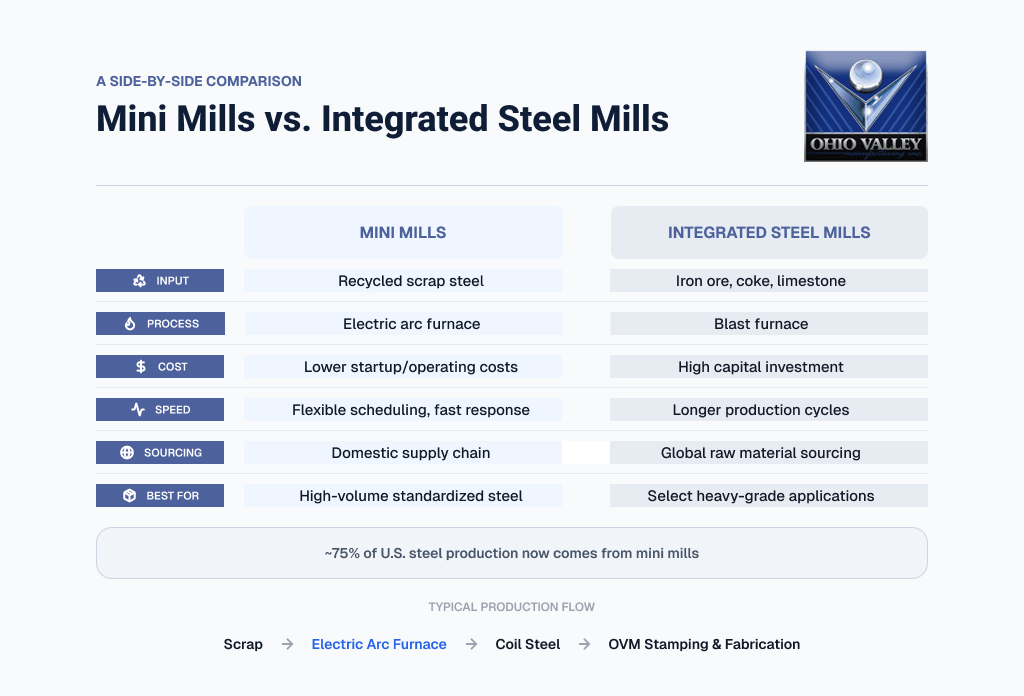
Mini Mills vs Integrated Steel Mills
The differences between these two systems influence purchasing decisions and supply chain planning.
Mini Mills
Scrap-based input material
Electric arc furnace production
Lower startup and operating costs
Flexible production scheduling
Strong reliance on domestic supply chains
Faster response to demand shifts
Integrated Steel Mills
Iron ore and coal-based production
Blast furnace systems
High capital investment requirements
Longer production cycles
Greater dependence on global raw material sourcing
Best suited for select heavy-grade applications
Both systems remain active, but their roles in the market are increasingly distinct.
Domestic Capacity, Supply Strength, and Market Direction
Domestic steel capacity is now central to U.S. manufacturing stability. Mini mills strengthen this position by relying on domestic scrap supply and reducing exposure to global shipping disruptions. This structure improves material availability for key downstream industries such as automotive manufacturing, infrastructure, and heavy equipment production, while also allowing producers to adjust output more quickly to changes in demand.
At the same time, investment continues to shift toward mini mill expansion. Companies like U.S. Steel are investing in facilities such as Big River Steel while still operating traditional integrated assets, reflecting a broader move toward hybrid production strategies. Although integrated steel mills remain important for specialized steel grades, mini mills now lead in flexibility, cost efficiency, and scrap-based production, positioning them as a primary driver of modern U.S. steel capacity.
From Steel Supply to Finished Parts. Keep Production Moving
Steel doesn’t stop at the mill. After leaving mini mills and integrated steel mills, it still needs forming, stamping, and fabrication to become usable industrial components.
Ohio Valley Manufacturing, Inc. plays that downstream role, converting steel coil into heavy-gauge stamped and fabricated parts for high-volume production. When supply stability matters, having a fabrication partner aligned with domestic steel output helps keep programs moving.
Posted by Ohio Valley Manufacturing on | Comments Off on Toolmaker Job Opening at Ohio Valley Manufacturing
The manufacturing industry is often in the news. Politicians have many opinions to the health of the industry and where it is, or should be, headed. While we can’t predict the future, we can realize the present. Today, we see an expanding customer base, additional work, and the need for more employees.
Our recent expansion provided us with a new press and a larger manufacturing space. We are still growing and the manufacturers we serve—vehicle, appliance, agriculture equipment, etc.—need more from us. They truly understand the experience and value of working with Ohio Valley Manufacturing.
We are currently looking to hire a Toolmaker. The position requires analysis and maintenance of the tooling used in the production pressroom. The ideal candidate should have a High School diploma or GED and be a graduate of a Tool and Die Maker Apprenticeship Program or have 7 years shop-related experience.
What does a toolmaker for Ohio Valley do? The Toolmaker is responsible for
Performing set up and operation of machine tools
Analyzing and repairing production tooling
Assisting in training of Toolmaker Apprentices
Operating towmotors
Operating overhead cranes
Other duties as assigned
In business since 1999, Ohio Valley Manufacturing continues to employ accomplished and experience people who can consistently produce the highest quality parts. Our highly experienced personnel work to nurture younger employees and pass on this invaluable expertise.
To learn more about the Toolmaker position and working at Ohio Valley, please contact us.
Posted by Ohio Valley Manufacturing on | Comments Off on June is National Safety Month… But We Focus on Safety in Manufacturing and Employee Safety Training Every Month of the Year!
Safety in the workplace is a hot topic in the news right now because June is “National Safety Month,” an annual event established in 1996 by the National Safety Council (NSC). The theme for this year’s National Safety Month is “Safe For Life” and the event is focused on “reducing leading causes of injury and death at work, on the roads and in our homes and communities.” NSC is dedicated to promoting safety through advocacy, research, education and training, and at Ohio Valley Manufacturing, we are dedicated to safety, too. We believe safety training is important, and all of our employees participate in safety training courses offered throughout every year.
A recent report from ManufacturingTomorrow.com about trends affecting safety in the workplace says, “Safety has always been and will continue to be a top concern for companies. The rate of non-fatal occupational injury in 2014 was 107.1 per 10,000 workers resulting in 1,157,410 recuperation days away from work… Safety requires constant vigilance.” At Ohio Valley Manufacturing, we couldn’t agree more!
Yes, we’re known for “stamping out the competition” with our “impressive capacity” in providing high-quality heavy-gauge stamping and precision blanking services to our customers in a variety of industries (agriculture and automotive, to heavy trucks and trailers, and other industries, too). But, Ohio Valley Manufacturing is also known for putting safety first at our company. All of our employees participate in safety training programs and courses throughout the year, with each employee required to attend these and other safety training courses:
Confined Space Training
Overhead Crane Safety
HAZ Comm/Lock-Out/Tag-Out Procedures Training
Powered Industrial Truck Safety
OSHA General Safety & Health Training
CPR training, and
GHS (UN Globally Harmonized System of Classification and Labeling of Chemicals) Implementation.
Also, in reference to the GHS Implementation, we have a staff member who is 100% dedicated to GHS, which requires Safety Data Sheets (SDSs), formerly MSDS for hazardous chemicals.
Plus, in addition to the safety-specific training, designated employees are fully trained in operation of all of our power presses, ensuring their comfort with each skilled operation they perform. Like we said before, yes we’re focused on “stamping out the competition” with our services. But, at Ohio Valley Manufacturing, we’re also focused on surpassing safety standards and expectations – and stamping out safety issues – by focusing on safety and employee safety training every month of the year!
For Ohioans it may not be a surprise that our state is an auto manufacturing hub. Recently, Honda, Ford, and Mitsubishi all announced plans to manufactures in Ohio. Honda will be expanding its capacity of its East Liberty plant to keep up with the demand for more trucks, SUVs, and crossover vehicles. Mitsubishi is once again expanding its Mason facility. The company sees a growing North American automotive market and chose the Mason location due to its proximately to automakers, such as Toyota, GM, Ford, and Chrysler. Finally, Ford’s Cleveland plant will begin producing the EcoBoost engines for the first time in North America. Previously this engine was made in Valencia, Spain but Ford has decided to move production to reduce shipment and production costs.
At Ohio Valley Manufacturing we work with a variety of industries, including automobile, trucks, RV, appliances, agricultural equipment, and lawn and garden manufacturers to provide blanking, stamping, tooling, and robotic welding services. To learn more about services, visit Ohio Valley Manufacturing online. We also maintain a Twitter and LinkedIn account where we post more company updates as well as manufacturing and trucking news.
Posted by Ohio Valley Manufacturing on | Comments Off on Ohio Continues to See Growth in the Manufacturing Sector
We recently came across an article talking about the continued steady growth of Ohio’s manufacturing sector and we’re excited to end the year on a positive note. Since Gov. John Kasich took office and implemented new policies to help the sector. National efforts of reshoring, STEM education, and manufacturing hubs have also helped to grow the industry. The growth in manufacturing is not only beneficial to manufacturers but also helps to bring more money into Ohio’s economy. George Mokrzan of Huntington Bank directly credits the resurging manufacturing sector for boosting consumer spending.
At Ohio Valley Manufacturing we have seen our own growth as well with more orders mostly due to Class 8 trucks and the rise of trailers. These increases have led us to expand our facilities to better serve our customers. This growth also means we need more skilled workers and we have posted two new job opportunities, one for a Tool & Die Design Engineer and a Toolmaker.
To learn more about our services, visit our website and be sure to follow us on Twitter and LinkedIn for more updates about our company, the manufacturing sector, and other industry news.